Measurement
Page changes are measured for 28 days. With an early reading on day 14.
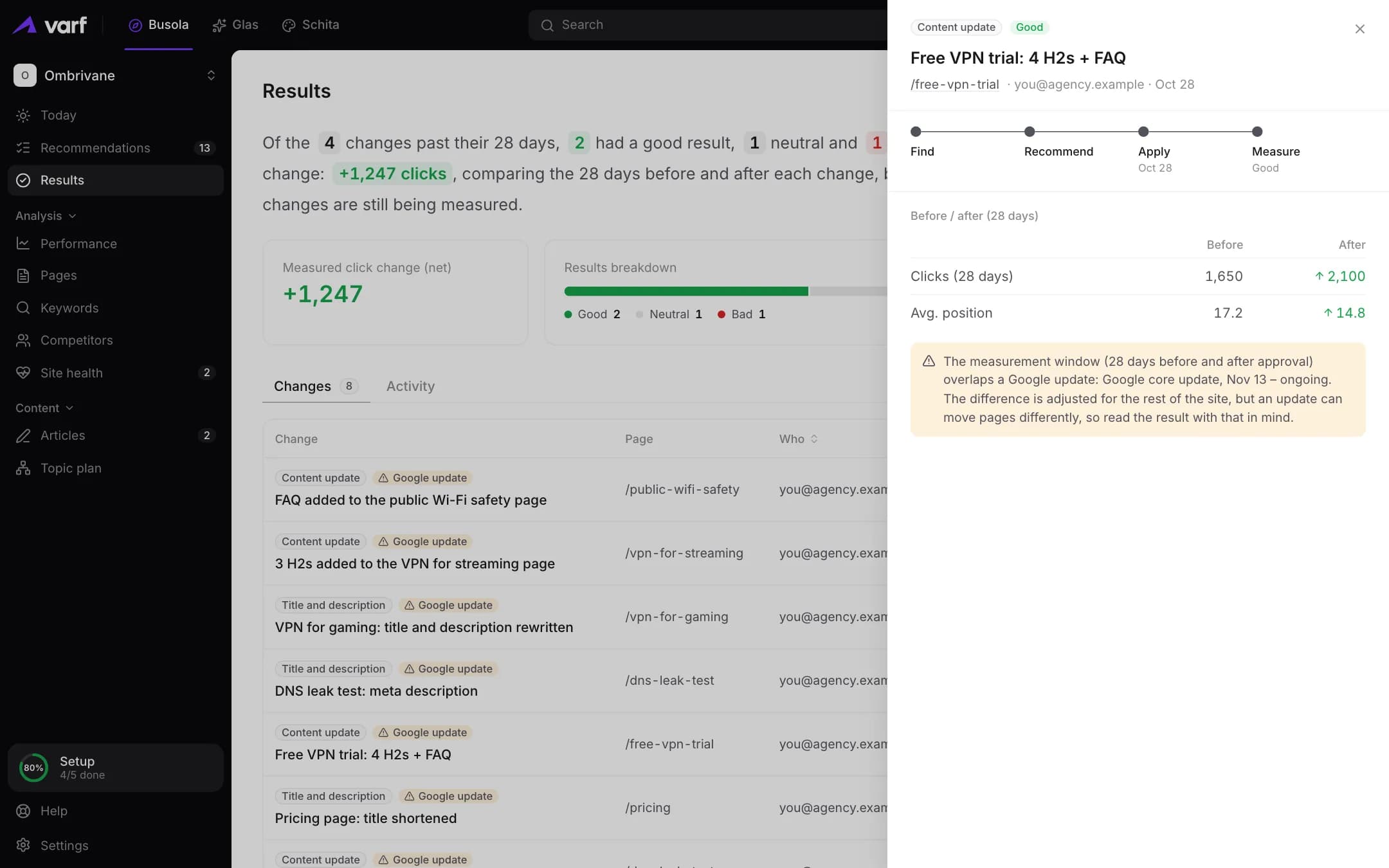
Varf measures the effect of each page change you approve. It compares the page’s clicks in the 28 days after the approval with the 28 days before, adjusts for your whole site’s trend and gives a verdict on day 28: good, neutral or bad.
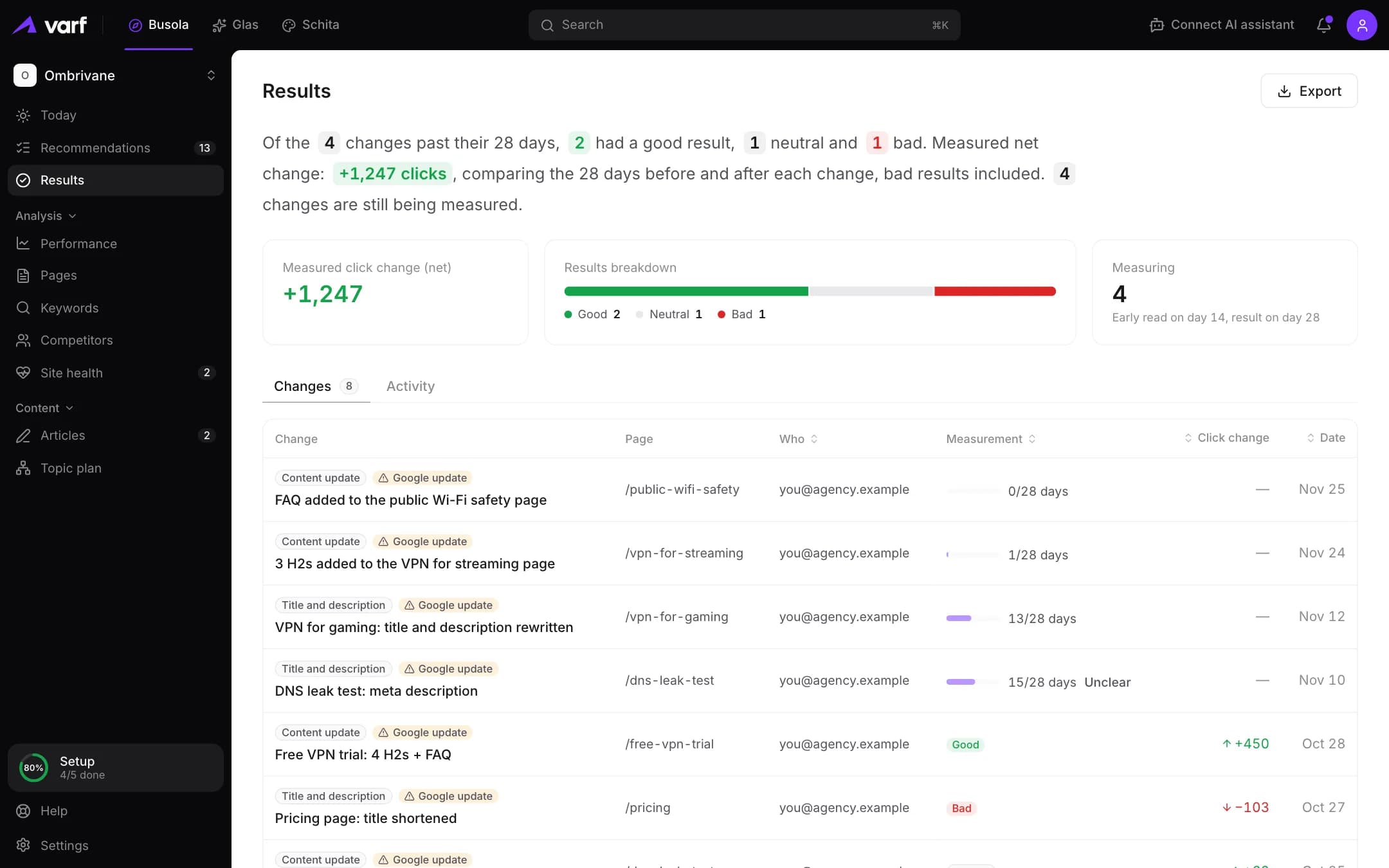
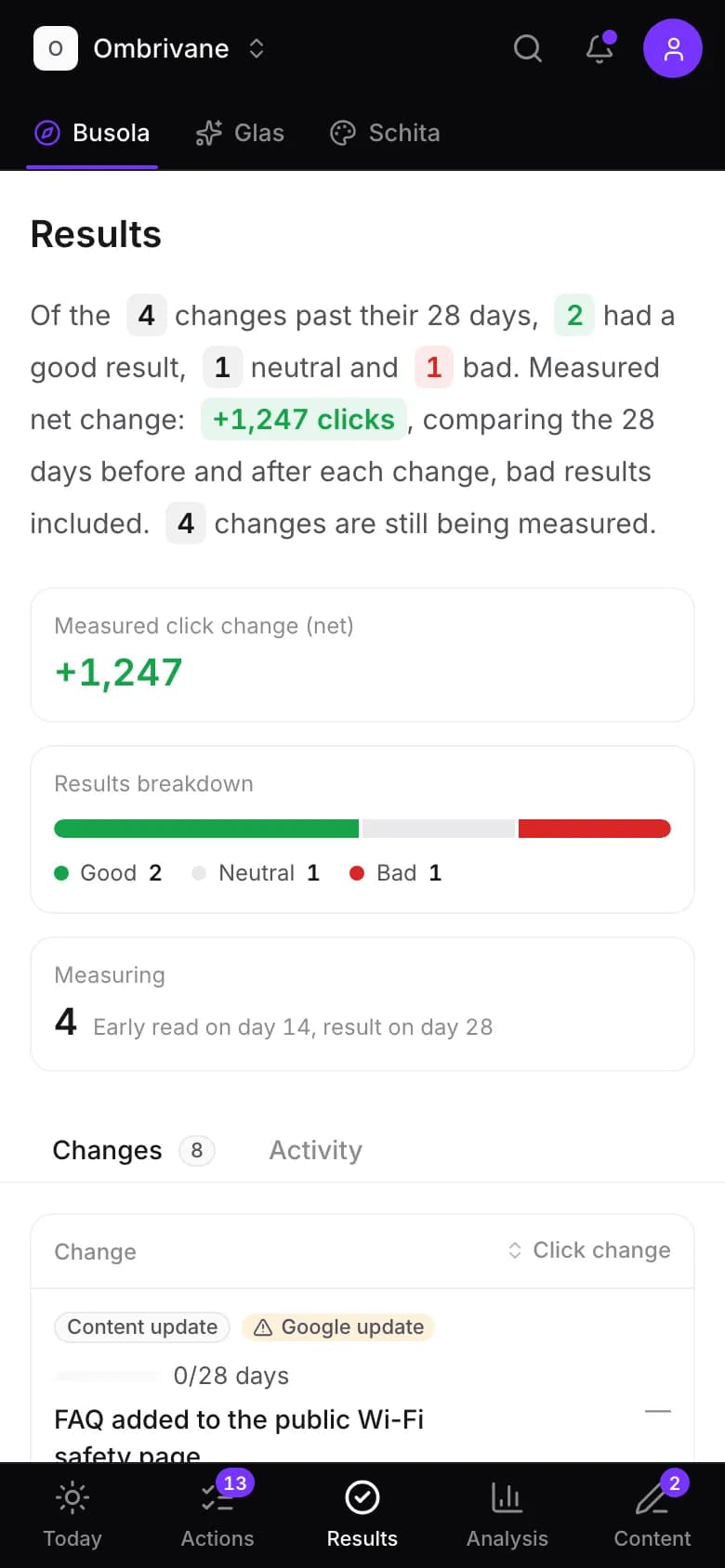
The 28-day window.
Measurement starts the day after you approve the change. That day itself is left out, because it mixes before and after.
- Before: the 28 days up to the approval.
- After: the 28 days that follow it.
- Four full weeks contain each day of the week four times, so weekly patterns cancel out.
Allowing for your whole site.
A page’s clicks rise and fall with the season and with your whole site. Varf expects the page to move like the rest of your site and measures the difference from that expectation.
- Expected clicks = clicks before × the change on the rest of your site.
- The result is the difference between actual and expected clicks.
Good, neutral or bad.
A verdict is good or bad only when the difference is large enough to trust: beyond random variation at about 95% confidence, and at least 10% of the expected clicks. Anything smaller is neutral.
Good
Clicks are clearly above expected.Neutral
No difference you can trust yet, either way.Bad
Clicks are clearly below expected. Varf flags it and recommends undoing the change.
An early reading on day 14.
From day 14 to day 27, Results show the direction so far: trending up, unclear or trending down. It is a reading, not a verdict; the verdict comes on day 28.
Speed fixes are measured in Chrome UX Report. Not in clicks.
Varf compares the phone’s LCP, INP and CLS for real Chrome visitors (75th percentile) in the 28 days behind the recommendation with the first weekly 28-day period that starts after you approve it.
- Good: a metric that was poor at approval improved by at least 10% and none got worse.
- Bad: a metric outside Google’s good range got at least 10% worse.
- Neutral: anything else.
What is measured.
Each recommendation you approve that changes one page: a new title and description for a low click-through rate, a content update for a near-win or for a page losing clicks. Speed fixes for the whole site or a key page are measured in Chrome UX Report, as above. Each result keeps the decision, who made it and the numbers before and after. Measuring other technical fixes, new articles and AI visibility work is coming soon.
Frequently asked questions
Why 28 days?
Four full weeks contain each day of the week four times, which evens out weekly patterns, and give Google time to recrawl and re-rank the page.
What if my traffic is seasonal?
Varf compares the page with the rest of your site over the same days, so a seasonal rise or fall that hits the whole site isn’t counted as the change’s effect.
What does neutral mean?
That the difference is too small or too noisy to call. Pages with little traffic often stay neutral, because small numbers vary a lot by chance.
Can I trust the day-14 reading?
It shows the direction so far. Treat it as a hint; act on the verdict on day 28.
How are speed fixes measured?
With Google’s Chrome UX Report instead of clicks. Varf compares the phone’s LCP, INP and CLS for real Chrome visitors before the approval with the first 28-day period after it. The result is good when a poor metric improved by at least 10% and none got worse.
What happens if a change is bad?
Varf marks it bad on Results, recommends undoing it on Today and notifies you. You revert it on your site; undoing a change from Varf is coming soon.
Where do I see the results?
On the Results screen, and on Today, which shows the latest verdicts.
Put your site on the loop.
Add your site and connect Search Console. Varf starts collecting right away and shows its first findings as soon as the first sync finishes.